|
|


|
 |
|
|
|
|
|
|
U 11, Hovgården, Adelsö | ||||||||||||||||
|
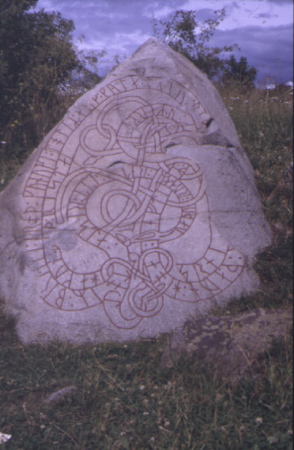
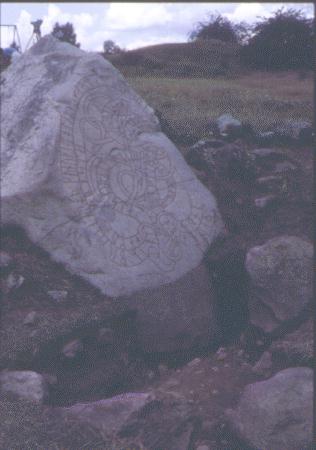
Photo of stone:
|
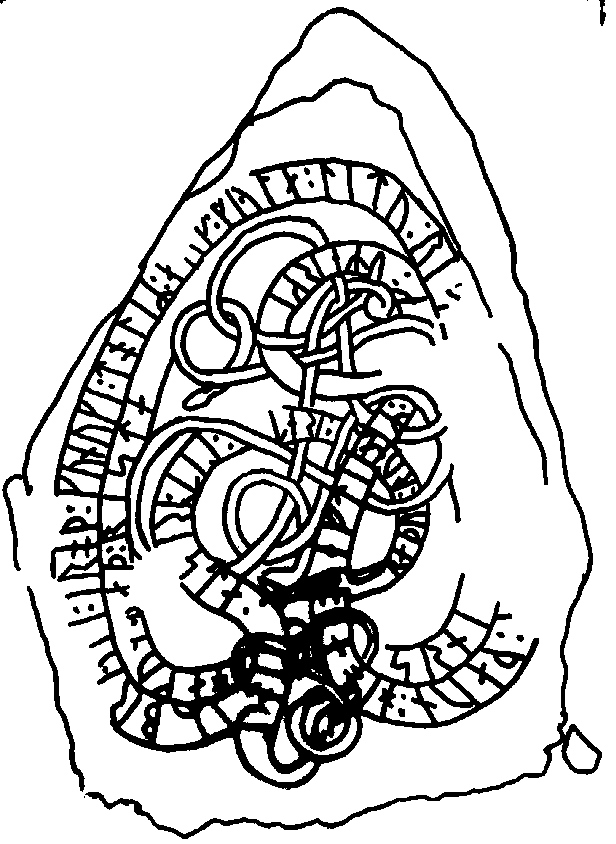
Drawing of stone:
|
|
Orginal ra?u:runaR:ret:lit:rista:toliR:bry[t]i:i ro?:kunuki:toliR:auk:gyla:litu:ris···-:?aun:hion:eftiR···k:merki *srni···*hakun*ba?:rista |
|
|
Swedish Tyd du runorna! Rätt lät rista dem Tolir, bryte i Roden, åt konungen. Tolir och Gylla läto rista (dessa runor), båda makarna efter sig till en minnesvård... Håkon bjöd rista. |
|
|
English You read the runes! Right let cut them Tolir, bailiff in Roden, to the king. Tolir and Gylla let cut (these runes), this pair after themself as a memorial... Håkon bade cut. |
|
The inscription is placed on a stone block, until 1994 thought
to be stationary. 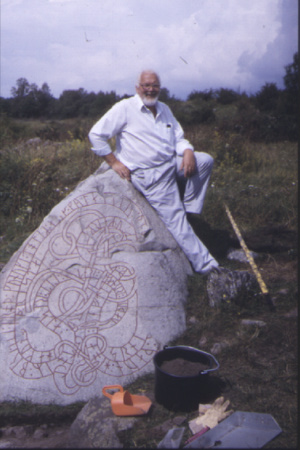 The surface has been carefully smoothed. The inscription was
partially damaged already in the 1700 century. It is not, as is
normal, made as a memorial for a dead relative, but to fulfil
a wish of a living king. Who Håkon was is unsure, perhaps the
king Håkon the red, named by Adam of Bremen. In that case the
stone can be dated to ca 1080 AD.
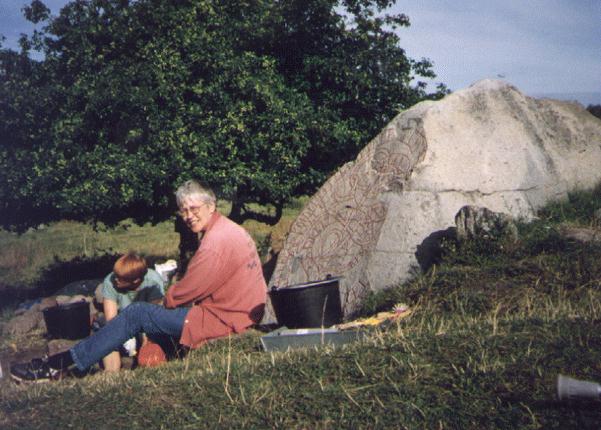
During 1990-1994 4 weeks each summer archaeological excavations have been carried out in the Hovgård area by amateurs in co-operation with the Archaeological institution of Stockholm University and the investigation department of RAÄ (Riksantikvarieämbetet). Hovgården is situated very close to the Björkö island, where the prototown Birka was placed. During 1990-1995 a professional excavation of the town area of Birka was carried out. Birka is today thought to have been a regulated town started ca 750 AD. It was suddenly abandoned during 950-1000 AD. Sigtuna has been established ca 980 AD as the first real Swedish town and the successor of Birka.
The Adelsö excavation is not up to now published. What can be said is that all viking age findings, some of high class, can be dated to the Birka period, nothing from the 1100 century (beside the rune stone). The stone has been placed in the stone wall, foundation of the bridges, which surrounded the harbour area. The best explanation, if the dating of the stone is correct, is that Hovgården became one of many regal farms and that the king wanted to make a sign of this.
 |
 |
| Different Views of this stone... | |
| Text written by: | Ingrid Karlmar and Urban Fredriksson |
| Home of original: | http://www.geocities.com/Athens/Olympus/1568/ |